Tip: you can listen while you read along, or close your screen and treat it as a podcast on the drive home.
Why this is Module 4. Modules 1 and 2 gave you the language to talk about lighting and sound. This module and the next take the step up: reading the design documents themselves, so you're not relying on the contractor to tell you what's on them. The lighting plot is where the rig is decided — and where over-spec is baked in before a quote is ever written.
What this module gives you. A lighting plot is a top-down architectural drawing of the venue, with every fixture marked in its position, with its channel number, gel code, mounting bar, and function. The LD hands it to you with the quote attached. After this module, you can read the plot well enough to: count the fixtures, cross-reference against the bill of materials, spot the over-spec items, and price the rig against current 2026 hire rates.
The 30-second test. By the end of this module, given a plot and a quote, you should be able to answer in 30 seconds: "is the fixture count fair for the venue size?" and "are the chosen fixtures appropriate for the budget?" Just those two questions, applied consistently, save 20-30% on the lighting line on most school musicals.
What's on a lighting plot
A plot looks intimidating — dozens of symbols, numbers and codes scattered across an architectural drawing — but it's built from the same five elements every time. Learn what each element is and the intimidation goes away: you stop seeing a designer's artwork and start seeing a shopping list with positions attached. Take the five in turn.
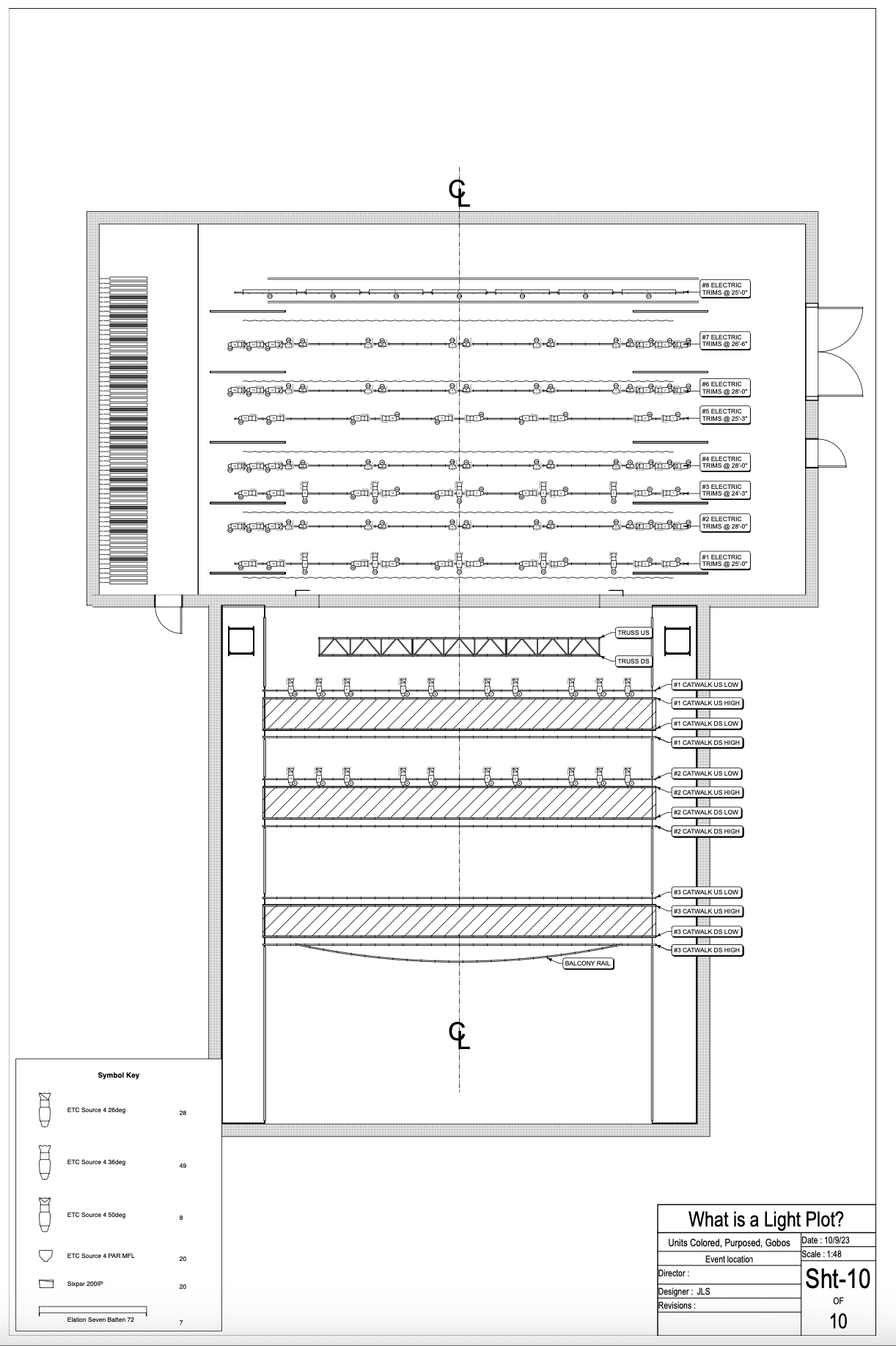
1. The venue floor plan
Top-down view of the stage + audience. Usually drawn at 1:50 scale (1 cm on paper = 50 cm in real life). Shows the stage area, the proscenium opening, audience seating, control booth, FOH bar position, fly bars (lines across the stage representing each LX bar at the trim height), and side stages or alley positions if used.
2. Fixture symbols
Each fixture type has its own symbol — typically a small simplified shape representing the lamp profile. Common symbols on a school plot:
- Source Four (ETC Source Four conventional) — long rectangular shape with a tail, like a stage pin
- LED PAR — circle with crosshair or hexagon
- LED wash — circle with rays / wings
- Moving head / spot — circle with a triangle or arrow indicating beam direction
- Cyc light / cyclorama — long rectangle, often colour-keyed
- Followspot — telescope-shape with a star or starburst
The plot's legend (bottom-right corner of the drawing) shows each symbol with its fixture-name caption. ALWAYS reference the legend when reading an unfamiliar plot — designers use slightly different symbol conventions.
3. Channel numbers
Small number written next to (or inside) each fixture symbol. This is the console channel that controls the fixture. Sequential, usually starting at 1.
Reading the channel-number pattern tells you about the design: 24 fixtures on channels 1-24 with no breaks = standard one-fixture-per-channel design. 12 fixtures on channels 1, 1, 1, 2, 2, 2, ... = grouped channels for a wash effect (one channel controls multiple fixtures). 84 fixtures on channels 1-200 with gaps = a moving-light show where channels are reserved for fixture parameters (pan, tilt, colour, gobo, intensity).
4. Gel codes
Small letter+number combo next to each fixture (or in the channel hookup table). Identifies the colour filter. Common references:
- L201, L202 — Lee 201/202 (Full and Half CT Blue, daylight-correction blues)
- L106, L105 — primary reds (Strawberry / Orange)
- L181, L182 — congo blues (deep)
- R02, R63, R80 — Rosco equivalents (similar palette)
- NC = no colour (clear / open white)
Gel choices tell you about the LD's intention. Lots of L201/L202 = white/daylight wash. Lots of L181 + L132 = romantic warm-cool. NC + open-white = no colour, used for key + texture (gobos take over the colour role).
5. The channel hookup / bill of materials
A sidebar table (usually right side of the plot) that lists every fixture with its: channel number / address / fixture type / position (bar) / unit number (1, 2, 3 across the bar) / focus area / gel.
This is the SHOPPING LIST. Count the rows, sum the fixture types, and you have the quote's bill of materials.
The 4-step plot-read
You don't read a plot the way the LD drew it — you read it for the four things that decide cost. Run the same four steps on every plot you're handed, in order, and you'll reach a defensible judgement in a couple of minutes: how many fixtures, whether that's right for the room, how many of them are the expensive moving kind, and whether the cyc wash is doubled up.
- Count fixtures by type. Walk down the bill of materials. Tally: "32 × Source Four LED, 8 × moving head, 12 × LED wash, 4 × cyc light, 2 × follow-spot". Total = 58 fixtures.
- Cross-reference against venue size. For a 280-seat school theatre, 30-45 fixtures is typical, 50-65 is generous, 70+ is high (and usually over-spec for the room). 58 fixtures is on the high end — defensible if the design needs it; questionable if you're trying to keep the rig hire under A$15k.
- Note the moving-light count. Moving lights cost 3-5× conventionals, so it's the line to understand — but don't reflexively cut it. In 2026 the expectation is a decent-looking show, and 8-12 movers is reasonable for a school musical when they're used well (they earn their keep by doing the work of many conventionals across scenes). 8 movers in a 58-fixture rig is about right. Where you push is when the count runs well beyond that for the room, or when the movers are touring-grade kit (Robe Pointe-class) where a school-grade mover would do — that's where the saving is, not in the count itself.
- Spot the cyc light cost. 4 cyc lights (units) is normal for a single cyc. If the plot shows 4 × top-cyc + 4 × bottom-cyc + 2 × ground-row = 10 cyc fixtures total, that's a heavy cyc wash design. The ground-row point is worth raising — unless a strong bottom-lit cyc is a specific look the production wants, in which case it's a conversation, not a cut. So ask the question rather than assume: "is the full top + bottom + ground-row coverage a deliberate look here, or could 6 fixtures deliver what we need?"
2026 AU hire-rate reference
Once you've counted the bill of materials, the rate card turns those counts into an expected number — your anchor for reading the quote. You don't need the contractor's exact margins; you need to know roughly what the rig should cost, so a quote that lands well above it becomes a question rather than a fact. Rates vary by contractor and city; these are mid-market averages for Melbourne/Sydney as of early 2026.
| Fixture type | Per day (mid-market) | Notes |
|---|---|---|
| Source Four LED (ETC S4 LED Series 3) | A$45-55 | Conventional workhorse; LED replaces the 750W incandescent |
| Source Four conventional + lamp | A$35-45 | Cheaper; lamps cost extra if blown |
| ETC ColorSource PAR | A$35-45 | LED PAR; good wash fixture |
| Chauvet / ADJ LED moving head (compact) | A$95-130 | School-grade moving light |
| Robe Pointe / DTS Alchemy mover | A$180-260 | Touring-grade; over-spec for most schools |
| Mac Aura moving wash | A$150-210 | Mid-grade; common for school musicals |
| Cyc light (single fixture, 4-cell) | A$80-110 | Per cell; 4 cells per fixture |
| Followspot (manual, 1.2-1.5kW) | A$220-320 | Plus operator (~A$90-120/hr) |
| Console: Yamaha QL1 / SQ-6 / X32 | A$200-350 | Suitable for school musicals |
| Console: ETC ION / Hog 4 / grandMA | A$700-1,200 | Pro / touring class |
| DMX cable run + signal split | A$80-120 | Per show; includes ~100m cable |
| EWP (scissor lift, 8m) | A$380-480 | Per day; access for rigging + focus |
Using the rate card above, expected hire for the 58-fixture plot (cyc + key + wash + 8 movers) over an 8-day production cycle (rig Sat-Sun + tech week 4 days + 4 show nights + strike):
- 32 × Source Four LED × A$50 × 8 days = A$12,800
- 8 × Mac Aura mover × A$180 × 8 days = A$11,520 — OR — 8 × Chauvet/ADJ mover × A$110 × 8 days = A$7,040 (saving A$4,480 if substituted)
- 12 × ColorSource PAR × A$40 × 8 days = A$3,840
- 4 × Cyc light × A$90 × 8 days = A$2,880
- 2 × Followspot × A$280 × 4 show days = A$2,240
- Console QL1 × A$300 × 8 days = A$2,400
- DMX cable + signal split × A$100 × 8 days = A$800
- EWP × A$430 × 2 days = A$860
Total at mid-market with school-grade movers: A$32,860. If a quote significantly exceeds this for the same plot, you have ammunition. If it's significantly below, ask what's being substituted out.
The 30-second test you can run after reading any quote: "the rate card says this plot should cost ~A$30-35k. Your quote is A$48k. What's the difference?" That question alone moves the conversation from "trust the contractor's number" to "explain the gap".
Spotting the over-spec design
The rate card catches a quote that's priced too high for the plot. But sometimes the plot itself is the problem — over-engineered at the design stage, so even a fairly-priced quote comes out expensive. These are the patterns to recognise on the drawing before any pricing happens, each with the single question that opens the conversation about trimming it.
| Pattern on the plot | Why it's over-spec | What to ask |
|---|---|---|
| Every fixture on its own channel (1:1 mapping) | Expensive console + cabling; usually unnecessary for school work | "Could we group fixtures by function (key, fill, wash) on shared channels? Reduces console size + cabling." |
| Touring-grade movers (Robe Pointe-class), or a mover count well beyond ~12 | 8-12 movers is reasonable in 2026; the cost trap is touring-grade kit where a school-grade mover would do, or a count the room can't justify | "Could we run school-grade movers (Chauvet/ADJ-class) instead of touring kit? And is the count right for a 280-seat room?" |
| Many specific gel codes from multiple manufacturers | Gel stock cost + complexity | "Could we standardise gels to a school-friendly palette of 8-10 codes from one stock pack?" |
| FOH bar at unusual height (e.g., requiring scaffold not EWP) | Adds rigging/access cost | "Can the FOH bar fly to standard trim, or does this design require scaffold access? If scaffold, the EWP line on the quote should be different." |
| Dimmer rack of 24 channels for an 8-fixture show | Over-spec on power infrastructure | "Could a 12-channel rack suffice? Or are we LED-only and don't need dimmers at all?" |
| Cyc lights + side-lit cyc + back-cyc all at full intensity | Triple-coverage of the cyclorama — often more than the look needs, but sometimes a deliberate choice | "Is the full cyc coverage a specific look you want, or can we achieve it with top + bottom only?" |
Where the Suite helps (and where it doesn't)
Straight up: the Suite isn't a lighting-plot drafting tool, and we won't pretend otherwise — the real plot is drawn in Vectorworks Spotlight, Lightwright or ETC Eos Augment3d, and that's the LD's job, not yours. What the Suite does is hold you to the numbers once the plot exists: EasyScheduler tracks the focus + strike hours against the quote, so when the quote says four hours of focus you can see whether four hours is what it actually took; and EasyRisk's hazard library carries the rigging/working-at-height hazards for hanging that rig. Read the plot here; verify the spend and the safety there.
EasyScheduler · Focus hours EasyRisk · Rigging hazards
Exercise 1B-4.1 — Read a real plot
Open the annotated sample plot in the resource pack. Run the 4-step plot-read on it: count fixtures by type, cross-reference venue size, note moving-light count, spot cyc-light over-spec. Write a paragraph summarising your read. Save to portfolio.
Exercise 1B-4.2 — Price the plot against the quote
Take the same sample plot + the sample lighting hire quote. Apply the 2026 rate card to price the plot, then compare to the quoted total. Identify the lines where the quote exceeds the rate card and draft an itemisation request.
Knowledge check
These are for your own reflection — not graded. Your answers save automatically to this browser.
1. You're handed a plot for a 280-seat school theatre with 84 fixtures, 12 of them moving heads. The mover count is fine for 2026 — so what's the part you'd actually question, and what's your first question to the LD?
2. The plot shows every fixture on its own channel. Why might this be over-spec'd, and what alternative do you propose?
3. Looking at the gel codes, you see 14 different codes from 3 manufacturers. What's your concern, and what would you ask?
4. Using the 2026 rate card, what's the approximate hire cost (8-day cycle) for 30 Source Four LEDs, 4 ADJ moving heads, and a Yamaha QL1 console + cabling?
5. The plot's bill of materials lists 4 cyc lights + 4 sky-cyc lights + 2 ground-row lights. When is this over-spec, and when might it be a deliberate look you'd keep?
6. A quote of A$48,000 is presented for a plot that prices at A$32,000 on the rate card. What's the 30-second-test question you ask?
Resources
Everything you need to read and price a plot. Open each in a new tab, print or save as PDF.
| Resource | What it's for |
|---|---|
| Annotated Sample Lighting Plot | A real anonymised school-musical plot with the 4-step read demonstrated line-by-line. |
| 2026 AU Hire-Rate Reference Card | Per-day rates to price a plot — updated annually. |
| Fixture-Symbol Legend | USITT symbols and what each represents — decode any plot. |
| Bill-of-Materials → Circuit-List Template | Drop in fixture counts, get the expected rate-card total. |
| Plot-Reading Checklist | Fifteen questions to ask any plot you're handed. |
| Gel Cut-List Template | Every gel × size × count needed, with a worked example. |
| Focus-Session Prep Checklist | What to have ready in the hours before the focus call. |
| Plot Revision Tracker | Version history: date / who / what changed / cost impact. |
| Key Numbers on a Plot | What every number means — channel / dimmer / address / position / lens / wattage. |
| Plot BS-Detector | Six common over-spec patterns and the question for each. |
| Gel-Code Reference | Common Lee + Rosco numbers used in school work, with sample looks. |